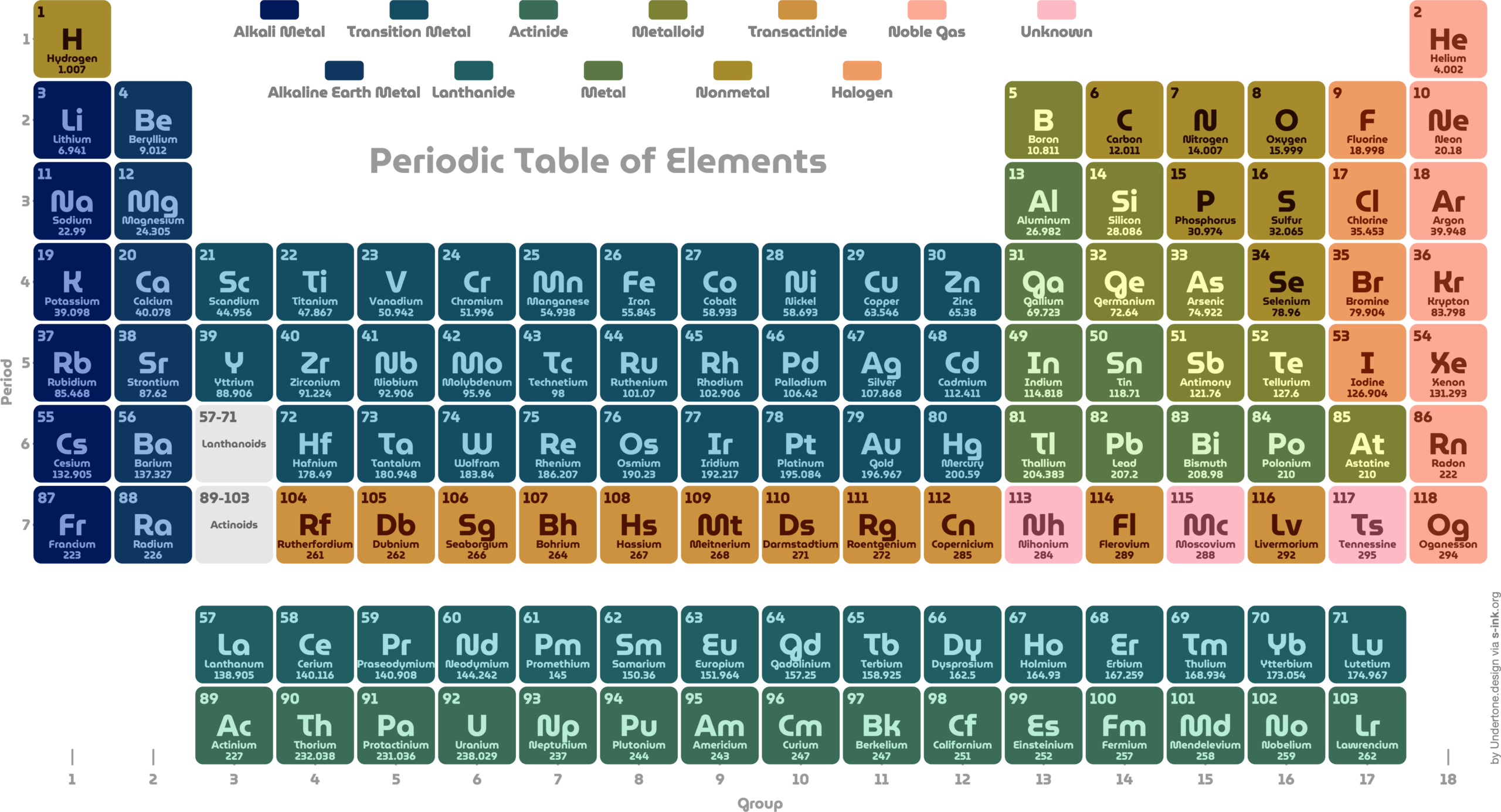
The periodic table is one of science’s most elegant and useful tools, organizing all known chemical elements according to their properties and revealing patterns that predict behavior. Its development represents one of chemistry’s greatest achievements, transforming element collection from mere list into meaningful framework.
The Periodic Table of Elements

Dmitri Mendeleev published first recognizable periodic table in 1869. Arranging elements by atomic weight, he noticed properties repeated periodically. Crucially, he left gaps for undiscovered elements and predicted their properties with remarkable accuracy. When gallium, scandium, and germanium were discovered matching predictions, his table gained acceptance.
Modern table arranges elements by atomic number (protons), not atomic weight. This resolved inconsistencies in Mendeleev’s arrangement. Henry Moseley established this through X-ray experiments in 1913, providing physical basis for periodic law. Today’s table contains 118 confirmed elements, with more possibly synthesized.
Rows are periods. Elements in same period have same number of electron shells. As you move left to right across period, atomic number increases, atomic radius generally decreases due to increasing nuclear charge pulling electrons tighter. Properties change systematically across periods.
Columns are groups or families. Elements in same group have same number of valence electrons (outermost electrons), giving them similar chemical properties. Group 1 (alkali metals) are highly reactive, losing one electron easily. Group 18 (noble gases) are nearly inert, having full valence shells.
Metals dominate left side and center. They conduct electricity, are malleable and ductile, and tend to lose electrons forming positive ions. Most elements are metals. Their properties make them essential for construction, electronics, and countless applications. Iron, copper, aluminum, gold exemplify metals.
Nonmetals occupy upper right. They are poor conductors, often gases or brittle solids, and tend to gain electrons forming negative ions. Carbon, oxygen, nitrogen are essential for life. Halogens (group 17) are highly reactive nonmetals. Their properties differ dramatically from metals.
Metalloids form diagonal boundary between metals and nonmetals. Silicon, germanium, arsenic have intermediate properties, behaving as semiconductors—conducting electricity under some conditions but not others. This property makes them essential for computer chips and electronics.
Transition metals occupy central block. They have variable oxidation states, form colored compounds, and often serve as catalysts. Iron in hemoglobin carries oxygen. Cobalt in vitamin B12 is essential. Platinum catalyzes reactions. Their electron configurations enable unique properties.
Lanthanides and actinides sit below main table. These inner transition metals have similar properties within each series. Lanthanides used in magnets, lasers, and phosphors. Actinides are radioactive; uranium and plutonium fuel nuclear reactions. Their placement reflects electron filling patterns.
Periodic trends reveal predictable patterns. Atomic radius decreases left to right, increases top to bottom. Ionization energy (energy to remove electron) increases left to right, decreases top to bottom. Electronegativity (attraction for bonding electrons) follows similar pattern. These trends enable property prediction.
Elements with atomic numbers above 92 (uranium) are synthetic, created in laboratories through nuclear reactions. They are unstable, decaying rapidly. Their discovery extends periodic table and explores nuclear stability. Island of stability theory predicts relatively stable superheavy elements may exist.
Isotopes of same element have different neutron numbers. Some isotopes are stable; others radioactive. Carbon-14 dating, uranium-lead dating, and medical isotopes all exploit radioactive decay. Isotopic composition varies naturally and can provide information about origin and age.
Element names reflect history. Some named for mythological figures (thorium for Thor), places (germanium for Germany, americium for America), scientists (curium for Curies), or properties (chlorine from Greek chloros meaning green). Each name carries story of discovery and cultural context.
Periodic table’s power lies in prediction. Unknown element properties can be inferred from neighbors. Chemical behavior follows position. This organizational principle enables chemists to understand reactions, design materials, and explore matter’s fundamental nature.
The periodic table adorns classrooms worldwide because it works. It organizes chemical knowledge, reveals deep patterns, and connects macroscopic properties to atomic structure. In elegant rows and columns, it captures order underlying apparent diversity of material world.
